Following are a few case study write-ups I had to translate for the poverty alleviation project we recently finished up. I thought I'd copy and paste them here to give a bit of a glimpse into the common hardships of the Chinese farmer:
1. Sun Guo Chun (孙国春) is one of the farmers who received aid funds through our “Especially Impoverished Farmer” aid program. Sun Guo Chun lives in HuaXi township, Village #8, District #3. At 54 years of age, Guo Sun Chun is unable to work and earn money due to an injury he suffered in 1997: while working to break apart boulders for use in construction, road repair, etc., a large rock landed on him and the pressure broke his right leg. His leg did not heal properly and still gives him trouble when he does hard labor. His wife, 54 years of age, also suffers from health problems—she has uterine fibroids that cause her pain and discomfort, yet she cannot afford to seek a medical solution to the problem. Sun Guo Chen and his wife have one son and one daughter, though the daughter has already divorced and her ex-husband left her with their mute son. While Sun Guo Chun’s grandson can understand those who talk to him, he cannot speak and thus requires extra care. Finally, Sun Guo Chun’s son left the countryside to seek paid work in Guangzhou province, but has not returned home in over two years.
2. Li Dong Yun (李东远) is a farmer who received funds through the “Especially Impoverished Farmer” aid program. He lives in HuaXi township, Village #8, District #3. Li Dong Yun is 51 years of age and his been living by himself for over three years, since his wife became ill and passed away in 2006. He looks after himself, but his high blood pressure and poor vision prevent him from partaking in any income-generating activities. As a result, he lives in a very tiny and dilapidated home with large cracks and holes in the crumbling structure. His home only has a small bed, a table, and a couple other personal belongings as he cannot afford to buy anything. He has one son who is 28 years old and does paid labor in Zhejiang province, however it has been a few years since his son was last in touch with his father.
3. Ji Chang Long (纪昌龙) is a rural peasant living in HuaXi Township, Village #9, District #4 who has received money from the “Especially Impoverished Farmer” aid program that we conducted with China Foundation for Poverty Alleviation. At 47 years of age, Ji Chang Long lives by himself in a single room that is part of a courtyard dwelling shared with several other families. His room has only a bed and small table for his belongings, and has a gaping hole in one of the walls that he cannot afford to repair. This damage to his home will prove to be a huge burden during the cold winter months as the inside will be fully exposed to the elements. Furthermore, it is nearly impossible for Ji Chang Long to find any form of paid labor, as he suffers from slight mental disabilities. In 1990 he went to Beijing to seek work in construction, yet was swindled out of all his money by someone who accompanied him in seeking employment. Later, while in Beijing, he fainted and passed out at work, causing further damage to his mental awareness. While he can still cook food and generally look after himself, his brother often assists him as the only way to financially support himself is by collecting garbage.
Showing posts with label rural China. Show all posts
Showing posts with label rural China. Show all posts
Saturday, December 12, 2009


Monday, November 23, 2009
Images of Rural China
A few photos I managed to snap while doing fieldwork last week:
An elderly couple relaying the story of their family’s living situation

Images of Chairman Mao still preside over many rural homes

A young girl in the village

Rural Poverty Issues
As I've described in previous posts, one of the main fieldwork projects I've been involved in at the NGO where I work has been one in which we're giving out cash grants to a number of particularly impoverished rural farmers, with funding we received from the China Foundation for Poverty Alleviation. We've distributed money to 120 out of the total 300 households that will receive the grants, and met with local village leaders a couple weeks ago to receive nominations for the remaining 180 recipients.
This past week, we returned to the countryside once again to conduct home inspections of the remaining 180 nominated recipients. Because money tends to be scarce for almost everyone in the countryside, my colleagues want to ensure that we are giving the funds to those who need it most and that the nominees weren't recommended because they happen to be a friend or family member of the leader who nominated them, or because the parameters of the project weren't clear to those making the nominations. We visit every home, look around the inside and take photos for later reference, talk to the resident to get a better understanding of his or her circumstances, and generally evaluate whether or not we agree that the person's situation is particularly difficult or impoverished.
The home visits, while exhausting (I actually contemplating crying and refusing to work one damp, snowy day because I thought I might actually freeze to death), have been insightful and have shed tremendous light on some common situations in rural China. The most prevalent phenomenon, by far, has been that of family members leaving their home to seek work in some of China's larger cities, as there is no way to earn an income from rural subsistence farming. While I was familiar with the sight of migrant construction workers toiling away on Beijing's highrise buildings, or the inflection of restaurant staff whose spoken Mandarin hinted at simple origins in a distant province, I was never fully aware of the extent to which this phenomenon occurs. In every single household we visited, the majority of the working-age family members (those over 18 years of age up to those who were not yet grandparents--roughly in their 50s) had left the countryside to seek work in other cities and provinces. Guangdong and Xinjiang provinces were particularly popular markets for their manufacturing and coal mining industries, respectively. Still others had headed for Beijing, Zhejiang Province, and Shenzhen, to seek construction work, restaurant work, or a host of other odd-jobs. The workers send monthly remittances back to their family members in the countryside, allowing for a cash flow into rural households. However, it also leads to a situation in which many children are raised by their grandparents and only see their parents once annually, at the Chinese New Year holiday. Spouses who work in different cities will also often rarely see each other; in extreme cases, some may even leave their families and never return home--a few households shared stories of parents who had left behind a sick or disabled child, who had met another partner while working in the city and divorced their spouse, or who had simply left to work in the city, never to be heard from again.
This past week, we returned to the countryside once again to conduct home inspections of the remaining 180 nominated recipients. Because money tends to be scarce for almost everyone in the countryside, my colleagues want to ensure that we are giving the funds to those who need it most and that the nominees weren't recommended because they happen to be a friend or family member of the leader who nominated them, or because the parameters of the project weren't clear to those making the nominations. We visit every home, look around the inside and take photos for later reference, talk to the resident to get a better understanding of his or her circumstances, and generally evaluate whether or not we agree that the person's situation is particularly difficult or impoverished.
The home visits, while exhausting (I actually contemplating crying and refusing to work one damp, snowy day because I thought I might actually freeze to death), have been insightful and have shed tremendous light on some common situations in rural China. The most prevalent phenomenon, by far, has been that of family members leaving their home to seek work in some of China's larger cities, as there is no way to earn an income from rural subsistence farming. While I was familiar with the sight of migrant construction workers toiling away on Beijing's highrise buildings, or the inflection of restaurant staff whose spoken Mandarin hinted at simple origins in a distant province, I was never fully aware of the extent to which this phenomenon occurs. In every single household we visited, the majority of the working-age family members (those over 18 years of age up to those who were not yet grandparents--roughly in their 50s) had left the countryside to seek work in other cities and provinces. Guangdong and Xinjiang provinces were particularly popular markets for their manufacturing and coal mining industries, respectively. Still others had headed for Beijing, Zhejiang Province, and Shenzhen, to seek construction work, restaurant work, or a host of other odd-jobs. The workers send monthly remittances back to their family members in the countryside, allowing for a cash flow into rural households. However, it also leads to a situation in which many children are raised by their grandparents and only see their parents once annually, at the Chinese New Year holiday. Spouses who work in different cities will also often rarely see each other; in extreme cases, some may even leave their families and never return home--a few households shared stories of parents who had left behind a sick or disabled child, who had met another partner while working in the city and divorced their spouse, or who had simply left to work in the city, never to be heard from again.
Thursday, November 12, 2009
Local Dialect
Last week entailed another long trip to the countryside and many hours of meetings conducted entirely in the local Sichuan dialect--the meetings are particularly brutal for me because I understand about 15-30% of spoken Sichuan dialect, depending on how familiar I am with the subject matter at hand. However, because DaBa (and, admittedly, just about any Chinese NGO) love the "face" and credibility they gain by having a foreigner working with them, I am unfortunately dragged along to attend every meeting. I generally sit there absentmindedly thumbing through my pocket Chinese-English dictionary and trying to avoid lung cancer & TB while the locals furiously chain smoke and spit all over the floor as they discuss who in their village should be nominated for the aid grants we are allocating. When the appropriate time arrives--my boss's mention of the fact that the "foreign friend" will be personally inspecting all the nominated households as an unbiased 3rd-party reviewer--I pull myself together and say that if we find that some households are above average and possess such items as a refrigerator, they will most certainly be eliminated from our list and will not receive the money that is intended for "especially impoverished" farmers. This statement is usually followed by them telling me my Mandarin is better than theirs, inquiring how much a plane ticket to the US costs, and asking me if I've gotten used to eating Chinese food. After the meeting finally concludes, we all sit down to a meal together in which copious amounts of warm beer and Chinese rice liquor are consumed, and I am forced to "gan bei" (the Chinese way of saying "cheers," though it literally means "dry your glass," and they really do make you finish all the beer in your mouthwash-cup-sized glass each time) with every Tom, Dick, & Harry Zhang, Li, & Wang in the village. Fortunately 4 years of college in the US trained my liver to be able to handle about twice what the average Chinese male can, so everyone is always super impressed with the "foreign friend."
Here is a fun countryside game for you: Which person in the below picture doesn't belong?

Here is a fun countryside game for you: Which person in the below picture doesn't belong?

Tuesday, November 10, 2009
The Other White Meat
I neglected to mention that, as part of the countryside celebrations of the Chinese National Day holiday, I also had the distinct pleasure of witnessing the slaughter of a live pig. By hand. No big deal. Tastes like chicken?


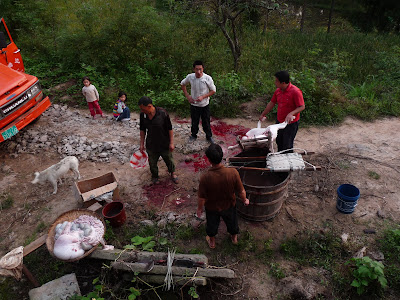
Step 1: pig is weighed

Step 2: Preparing for slaughter. Takes four dudes to mount the squealing animal on the bench.

Step 3: I just couldn't bring myself to witness the slitting of the throat, but here's the aftermath. Compare the metal bowl in this photo vs. in the previous one... Also, note the cigs hanging from everyone's mouth as they wrestle the animal to the ground with blood-covered hands. Ballers.

Step 4: Soaking the dead pig in a vat of hot water before skinning it

Step 5: Gutting the pig


Monday, November 09, 2009
60th Anniversary? Or 20th?
Several important anniversaries took place in China this year, depending on who you talk to. The second of these, on October 1st, was the 60th anniversary of the founding of the People's Republic of China. While the fanfare in Beijing nearly rivaled that of last year's Olympics (my favorite part is this clip is the smiling ethnic minority children enthusiastically waving), I had the distinct pleasure of spending the days leading up to the holiday in the countryside. Since a picture (or, in this case, a video) is worth a thousand words, I'll give you a little taste of my experience. I honestly felt like I had stepped in a time machine and traveled back to 1969 to celebrate the 20th anniversary, complete with several renditions of the most popular of Chinese Communist anthems, 东方红。
Subscribe to:
Posts (Atom)
